Brain Health
What is brain health?
Brain health refers to how well a person’s brain functions across several areas.
Areas of brain function
Motor function
Controlling movements and balance
Sensory function
Seeing, hearing, tasting, and smelling
Tactile function
Feeling and responding to sensations of touch, including pressure, pain, and temperature
Cognitive health
Thinking, learning, and remembering
Emotional function
Interpreting and responding to emotions
Learn more about keeping your brain healthy as you age:
www.nia.nih.gov/brain-health
Source: National Institute on Aging (NIH)
Choose Brain-Healthy Habits
Simple steps can make a difference.
There isn’t just one way to define brain health. According to an article on the Mayo Clinic Connect website, brain health includes our thinking, movement, senses, emotions, and behavior. These aspects all play a role in how we act, think, feel, and connect with others.
Six Pillars of Brain Health
Be Social
Keep in touch with friends & family, don’t let yourself get isolated.
Engage Your Brain
Find ways to stimulate your thinking, explore new interests and hobbies.
Manage Stress
Practice relaxation, take time for yourself.
Ongoing Exercise
Move throughout the day, target 2½ hours a week of moderate physical activity.
Restorative Sleep
Get 7–8 hours of restful sleep every day.
Eat Right
Choose a nutritious, heart-healthy diet of fish, veggies, and fruits.
4 Steps to Get Started
- Set a goal, identify a specific action you want to take.
- Find something fun; choose what you enjoy.
- Re-purpose some of your free time to make room for new healthy habits.
- Involve friends or family with common goals.
Lifestyle and genetics
Lifestyle and genetics are crucial factors in brain health. We can’t do anything about our genetics, but our lifestyle choices are up to us. Simple changes can make a difference.
Nutrition and the Brain
Eating healthy is one of the best ways to improve our overall well-being , but what being healthy looks like is different for everyone. Our bodies need different nutrients depending on things like age, genetics, lifestyle and health conditions. Because of this, it is important to get personalized advice. By talking to your healthcare provider about your eating habits, you can learn about how your diet affects your brain health and energy. They can give you helpful tips to make sure you are getting the right foods for your needs.
Access to fresh food can be challenging. Please click on the link below to view nutrition services available for older adults in New Mexico
Nutrition – New Mexico Aging and Long-Term Services Department – ALTSD
Understanding the Brain
Understanding the brain is the first step to keeping it healthy. This amazing organ is the most complicated one in our body and controls everything we do, from thinking and remembering to feeling emotions and moving our muscles. On average, the brain weighs about 3 pounds and is made up of 60% fat and 40% water, along with some salt, carbohydrates, and proteins. It also contains blood vessels and nerves. Together with the spinal cord, the brain forms our central nervous system, which helps regulate all our bodily functions
How Our Brains Work
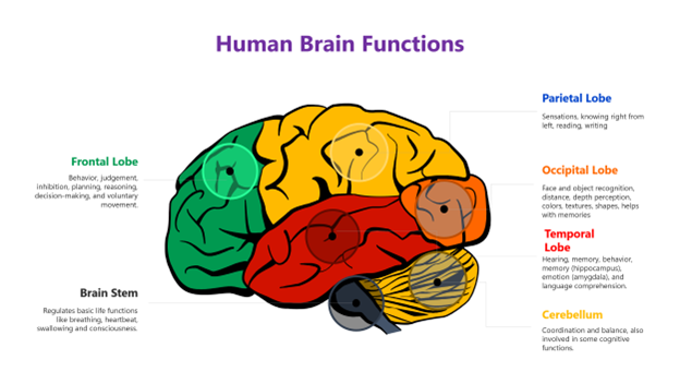
Human Brain Functions
Frontal Lobe
Behavior, judgement, inhibition, planning, reasoning, decision-making, and voluntary movement.
Parietal Lobe
Sensations, knowing right from left, reading, writing.
Occipital Lobe
Face and object recognition, distance, depth perception, colors, textures, shapes; helps with memories.
Temporal Lobe
Hearing, memory, behavior, memory (hippocampus), emotion (amygdala), and language comprehension.
Cerebellum
Coordination and balance; also involved in some cognitive functions.
Brain Stem
Regulates basic life functions like breathing, heartbeat, swallowing, and consciousness.
How Dementia Affects the brain
Source: The Scope of Dementia: Variants, Symptoms, Stages, and Causes
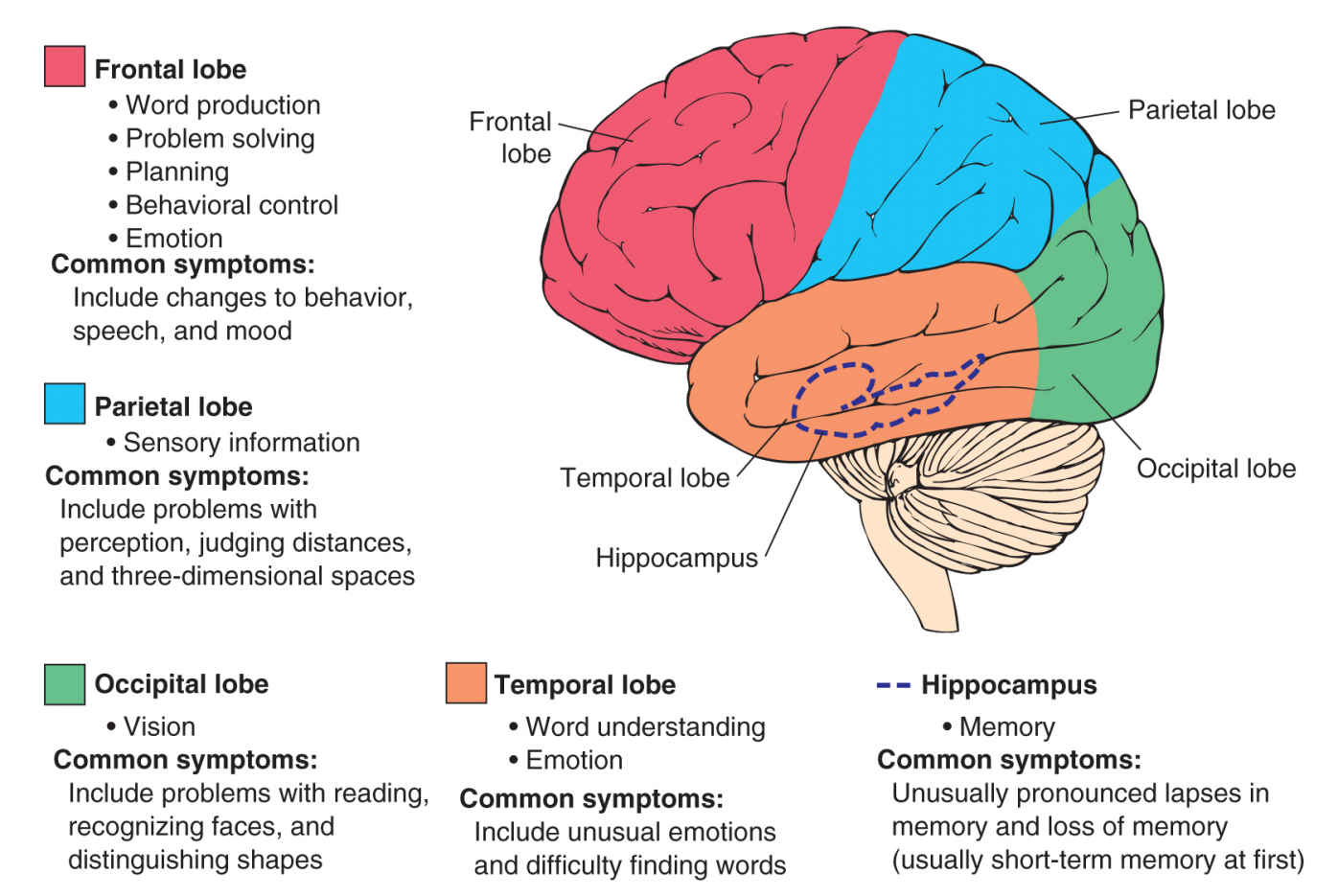
Brain Regions and Their Functions
Frontal Lobe
- Word production
- Problem solving
- Planning
- Behavioral control
- Emotion
Common symptoms: Include changes to behavior, speech, and mood.
Parietal Lobe
- Sensory information
Common symptoms: Include problems with perception, judging distances, and three-dimensional spaces.
Occipital Lobe
- Vision
Common symptoms: Include problems with reading, recognizing faces, and distinguishing shapes.
Temporal Lobe
- Word understanding
- Emotion
Common symptoms: Include unusual emotions and difficulty finding words.
Hippocampus
- Memory
Common symptoms: Unusually pronounced lapses in memory and loss of memory (usually short-term memory at first).
Podcasts
Podcasts can give you helpful tips and the latest information on these diseases and resources available.
To help you learn more and find support, search for these topics and terms on your favorite podcast app:
- “Dementia caregiver support”
- “Alzheimer’s research news”
- “Memory care strategies”
- “Dementia Early Signs & Diagnosis”
- “Brain Health”
- “Alzheimer’s and Dementia behaviors”
Memory Screenings
Detecting brain health problems early can help people get the care they need sooner. Screenings are not meant to diagnose issues; instead, they are a helpful first step to see if a full medical check-up is necessary. It’s important to talk to your doctor if you have any worries about your brain health. The Alzheimer’s Foundation of America offers free and private memory screenings to assist with this. Additionally, the University of New Mexico Center for Memory and Aging is a top research center focused on understanding brain conditions that affect thinking and behavior, especially in older adults.
Free Memory Screenings
- Memory Screening | Alzheimer’s Foundation of America
- Please click on the link below to find out more information on clinical care, research, participation in clinical trials and more.
- Memory & Aging Center | Neurosciences | UNM Health System | Albuquerque, New Mexico
What To Do After a Diagnosis
For more information visit Steps to Take After a Dementia Diagnosis
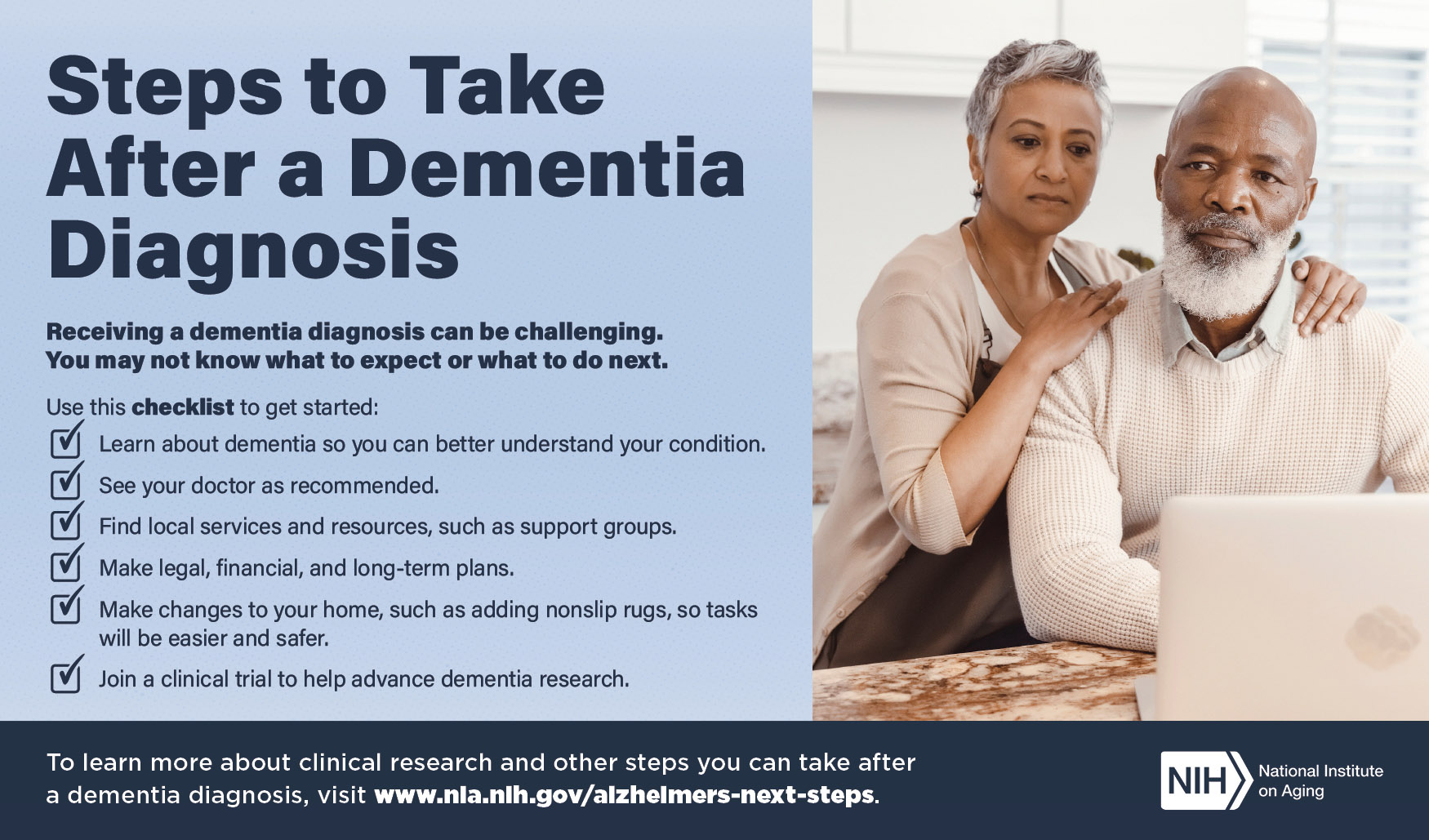
Steps to Take After a Dementia Diagnosis
Receiving a dementia diagnosis can be challenging. You may not know what to expect or what to do next.
Use this checklist to get started:
- Learn about dementia so you can better understand your condition.
- See your doctor as recommended.
- Find local services and resources, such as support groups.
- Make legal, financial, and long-term plans.
- Make changes to your home, such as adding nonslip rugs, so tasks will be easier and safer.
- Join a clinical trial to help advance dementia research.
To learn more about clinical research and other steps you can take after a dementia diagnosis, visit
www.nia.nih.gov/alzheimers-next-steps.
Source: National Institute on Aging (NIH)